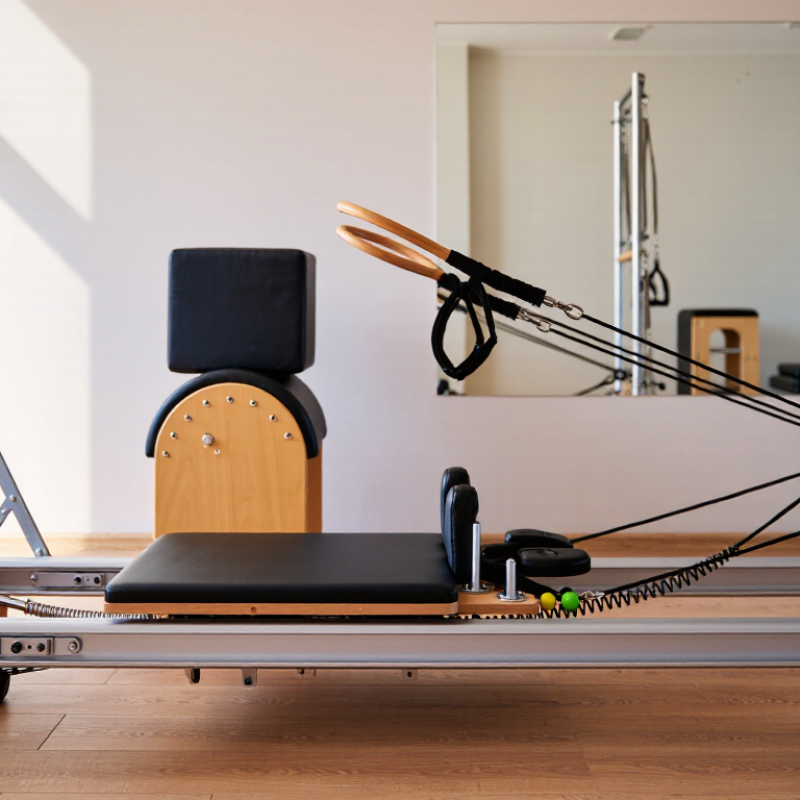
What Is a Reformer Pilates Machine?

A reformer pilates machine is a specialized exercise apparatus designed to support controlled, resistance-based movement. Its sliding carriage travels along rails. Springs create adjustable tension. A footbar, shoulder blocks, ropes, and straps help guide the body through each exercise. Unlike a simple mat routine, the machine can assist movement or make it more demanding.

In a Pilates studio, an instructor may adjust the spring color, rope length, and footbar position for each person. These details affect balance, joint alignment, and muscle control. A beginner might lie on the carriage and press through the footbar. The carriage moves quietly, while the springs provide steady feedback. Small changes can feel surprisingly difficult.

It is not magic. The reformer does not automatically correct poor technique or guarantee fast results. Safe practice depends on appropriate instruction, gradual progression, and attention to breathing and alignment. Research and professional Pilates guidance commonly emphasize controlled movement rather than speed or maximum resistance. People with injuries, pregnancy-related concerns, or ongoing pain should seek qualified medical advice before training. Equipment design also varies between studios and manufacturers, so the same exercise may feel different elsewhere. Understanding these limitations makes the reformer pilates machine more useful. It becomes a tool for developing strength, mobility, coordination, and body awareness, rather than a shortcut to fitness.

What Is a Reformer Pilates Machine?

Definition and Purpose of a Reformer Pilates Machine

A reformer Pilates machine is a sliding carriage system designed for controlled, resistance-based movement. It usually includes springs, ropes, a footbar, shoulder rests, and a stable frame. The user pushes or pulls the carriage while maintaining precise alignment. Springs can make an exercise lighter or more demanding. That adjustability supports beginners, athletes, and people rebuilding movement confidence.

Its main purpose is not simply stronger muscles. The reformer helps users practise trunk control, joint positioning, balance, and coordinated breathing. A physiotherapist or qualified instructor may adapt the equipment for limited mobility or postural weaknesses. However, it is not a medical treatment by itself. Research quality varies, and some claims about posture or pain relief remain less certain than marketing suggests. That matters.

Industry data shows why this equipment attracts attention. The Global Wellness Institute valued the global physical activity economy at about 1.1 trillion dollars in 2022, reported in its 2024 Global Wellness Economy Monitor. A 2024 global fitness booking report also identified Pilates as a leading class choice worldwide. These figures show strong participation, not proof that every reformer session produces the same result. ACSM’s fitness trend research continues to emphasize functional movement, qualified coaching, and exercise adapted to individual needs. In practice, a slow carriage glide, steady spring tension, and careful foot placement often matter more than dramatic movements. The machine looks simple. Using it well is not.

Main Components and How the Reformer Works

A reformer Pilates machine uses a moving carriage, resistance springs, and guided straps to create controlled exercise. The carriage slides along two rails inside a rectangular frame. Springs connect beneath it, changing the resistance from light to challenging. A footbar supports the feet or hands, while shoulder rests stabilize the upper body. Straps, usually held by the hands or placed around the feet, add pulling and pushing movements.

The machine works through tension and controlled instability. For example, during footwork, the user presses the carriage away and slowly returns it. The springs resist the push, while the abdominal muscles help keep the pelvis steady. During a chest-opening exercise, the straps move through the hands, encouraging shoulder control and spinal alignment. This explains why reformer training can feel demanding without heavy external weights. ClassPass’s 2024 Look Back Report listed Pilates as its most-booked workout globally for the second consecutive year, showing strong public interest. Popularity, however, does not prove that every exercise suits every body.

Tips: Start with low spring resistance and learn the carriage path first. Keep the ribs relaxed and avoid locking the knees. A qualified instructor should check foot placement, strap length, and joint alignment. Small details matter. In my experience, beginners often move too quickly, then mistake momentum for strength. That is worth reconsidering. The American College of Sports Medicine also emphasizes progressive resistance and proper technique, not simply increasing workload. If pain feels sharp, stop and seek professional assessment.

Key Pilates Exercises Performed on a Reformer

A reformer Pilates machine is a sliding carriage, not a simple weight machine. Springs create resistance, while straps, a footbar, and shoulder blocks guide movement. The carriage can feel unstable. That instability demands control from the hips, shoulders, and deep abdominal muscles.

Key Pilates exercises begin with footwork. Lying on your back, you press the carriage away through the heels, then return slowly. The hundred adds rhythmic arm pumps while the legs stay lifted. For a stronger challenge, long stretches move the body through a plank position. The feet may tremble. That is normal, but pain is not. A trained instructor should adjust spring tension and range of motion for each person.

The World Health Organization recommends 150–300 minutes of moderate physical activity weekly, according to its 2020 Guidelines. Reformer sessions can support that target, but they should not replace all aerobic exercise. The Global Wellness Institute’s 2023 report valued the global physical activity economy at about 1.1 trillion dollars in 2022. This figure reflects growing demand, not guaranteed results. Evidence for Pilates is promising, yet study quality and exercise methods vary. I would not treat every challenging position as automatically effective. Slow control often matters more than adding another spring.

Benefits of Reformer Pilates Training

What Is a Reformer Pilates Machine?

Benefits of Reformer Pilates Training

A reformer is a bed-like exercise machine with a sliding carriage, springs, straps, and adjustable resistance. It guides controlled movement while your muscles stabilize the trunk. Unlike ordinary mat work, the machine can support a beginner or challenge an experienced participant. A 2023 systematic review in Healthcare reported that Pilates may improve balance, flexibility, muscular strength, and quality of life. However, reformer-specific research remains smaller. The evidence is encouraging, not perfect.

Regular training may help improve posture and body awareness. It can also build core endurance through slow, precise movements. A spring-loaded footwork sequence makes the legs work without heavy impact. This may suit people returning to exercise, although individual needs differ. The World Health Organization’s 2024 global status report estimated that 31% of adults were insufficiently active in 2022. Reformer sessions cannot replace all aerobic exercise. They can provide a practical strength-focused option.

Tips: Begin with two supervised sessions weekly. Ask an instructor to check your spine, shoulder, and knee alignment. Keep the resistance moderate, especially during leg presses. You should feel effort, not sharp pain. Breathe steadily. Small movements often work better than forcing a deeper range. Do not assume advanced exercises are automatically more effective. A 2024 American College of Sports Medicine survey continues to emphasize safe, personalized, and sustainable exercise planning. That matters because progress can be slower than expected.

Safety Considerations and Choosing the Right Reformer

What Is a Reformer Pilates Machine?

Safety Considerations and Choosing the Right Reformer

A reformer is a sliding carriage, spring system, footbar, and strap assembly. It creates adjustable resistance while supporting controlled movement. The equipment looks calm. It is not automatically risk-free. The World Health Organization reported that 31% of adults worldwide were insufficiently active in 2022. That gap encourages more people to seek guided exercise, but rapid progression can still cause strain.

Check the machine before training. The carriage should move smoothly without scraping or sudden stops. Springs need clear resistance labels and secure attachment points. Inspect the straps, buckles, shoulder rests, and footbar for wear. A stable frame matters, especially during standing exercises. Beginners should choose a reformer with adjustable spring settings and a reliable stop system. Ask whether the instructor has recognized training and current first-aid knowledge. More expensive equipment is not always safer.

Start with basic footwork and slow carriage control. Keep your wrists neutral and avoid locking your knees. Stop when sharp pain, numbness, or dizziness appears. People with recent surgery, pregnancy-related concerns, or persistent joint pain should seek qualified medical advice first. The International Association of Physical Therapists emphasizes individualized assessment in movement rehabilitation, yet no checklist catches every problem. That is the uncomfortable part. A machine can be well maintained, while poor instruction still creates risk. My own preference would be conservative: lighter springs, fewer repetitions, and careful observation before increasing difficulty.

What Is a Reformer Pilates Machine? - Safety Considerations and Choosing the Right Reformer

Evaluation Dimension What It Is or Does Typical Information Safety Considerations What to Look For When Choosing
Basic Definition A reformer is a Pilates apparatus with a moving carriage, springs, ropes or straps, a footbar, and shoulder supports. It adds adjustable resistance and guided movement to Pilates exercises. It can support exercises performed lying down, sitting, kneeling, standing, or facing the footbar. Users should understand the carriage, springs, ropes, and footbar before beginning. Uncontrolled carriage movement can cause loss of balance or impact injuries. Choose a design that is stable, easy to understand, and appropriate for the intended experience level and training environment.
Carriage and Platform The carriage is the padded moving platform. It travels along a frame and creates resistance when the user pushes or pulls against the springs. Movement should be smooth and controlled, with enough padding to support the head, shoulders, spine, knees, and hips. Check that the carriage remains aligned and does not wobble, stick, or move unexpectedly. Keep fingers, toes, and loose clothing away from moving parts. Prioritize a stable frame, quiet rolling action, durable upholstery, and a carriage size that allows full movement without crowding.
Spring Resistance Springs provide adjustable resistance and may be used to assist movement, challenge muscles, or control the carriage. Many reformers use several springs with different resistance levels, commonly identified by color or position according to the equipment instructions. Never change spring settings while the carriage is unsecured unless the equipment instructions specifically permit it. Use lighter resistance when learning a new movement. Look for clearly labeled spring settings, secure attachment points, and replacement springs that are readily available and suitable for the equipment.
Footbar The footbar provides a surface for the feet or hands and may be adjustable for different exercises and body proportions. Some footbars have multiple height or angle positions and may fold or lower for storage. Confirm that the footbar is fully locked before applying force. Avoid placing weight on it when it is not designed to support that position. Select a reformer with a secure locking mechanism, useful adjustment options, and a height range suitable for the primary users.
Shoulder Rests and Headrest Shoulder rests help position the upper body, while the headrest supports the neck and head during lying exercises. Many models offer adjustable headrest positions and removable or adjustable shoulder rests. Use a neutral neck position and avoid excessive neck flexion. Make sure removable components are correctly installed before use. Choose firm but comfortable padding, secure attachment points, and adjustments that accommodate different heights and exercise requirements.
Ropes, Straps, and Handles These components connect the user’s hands or feet to the carriage and allow pulling, pushing, and assisted movement. Systems may use ropes, webbing straps, or a combination of both, with adjustable lengths for different exercises. Inspect for fraying, loose stitching, damaged clips, or worn pulleys. Keep straps organized to reduce trip and entanglement hazards. Look for smooth pulley action, comfortable handles, reliable clips, simple length adjustment, and clear maintenance instructions.
Frame and Stability The frame supports the carriage rails, springs, footbar, and other components. Frames may be designed for studio use, home use, or storage in a smaller space. Height and overall length vary by model. Place the machine on a level, non-slip surface with sufficient clearance around all sides. Stop use if the frame shifts, rocks, or produces unusual sounds. Compare weight capacity, footprint, frame rigidity, floor protection, and available space before purchase or installation.
Space Requirements A reformer requires room for the machine itself and additional clearance for the user’s arms, legs, and movement around the frame. Exact space needs depend on the model and exercises. A compact footprint does not always mean minimal operating space. Keep walkways clear and avoid placing the reformer near sharp furniture, heat sources, or unstable surfaces. Measure the available area, ceiling height, storage route, and access around the equipment before ordering.
User Skill Level Reformers can support beginners, but the moving carriage and spring resistance require instruction and body awareness. Beginners generally benefit from introductory sessions focused on alignment, breathing, spring control, and equipment setup. Start with basic exercises and conservative resistance. Seek qualified instruction for unfamiliar exercises or if technique is uncertain. For new users, prioritize clear setup guidance, instructional support, and simple adjustments over advanced accessories.
Physical Conditions Reformer Pilates may be adapted for different abilities, but exercises are not automatically appropriate for every person. People with injuries, recent surgery, pregnancy-related concerns, osteoporosis, balance limitations, or chronic conditions may need individualized advice. Consult a qualified healthcare professional when a medical condition, pain, recent surgery, or pregnancy affects exercise safety. Stop if sharp pain, dizziness, numbness, or unusual shortness of breath occurs. Choose an instructor or program that can provide appropriate modifications and understands relevant health considerations.
Maintenance Routine maintenance helps preserve smooth movement and reduces the risk of equipment failure. Typical tasks include cleaning surfaces, checking ropes and straps, inspecting springs, tightening fasteners, and keeping rails free of debris. Do not use damaged springs, frayed straps, cracked parts, or loose hardware. Follow the manufacturer’s maintenance schedule and replacement guidance. Consider service access, replacement-part availability, warranty terms, and how easily the machine can be inspected and cleaned.
Best Selection Priorities The right reformer balances user needs, available space, adjustability, safety, comfort, and long-term maintenance. Key comparison points include stability, carriage smoothness, spring range, footbar adjustment, padding, weight capacity, and storage options. Safety features and correct setup should take priority over appearance or the number of accessories included. Choose the most stable and adjustable option that fits the user, room, budget, intended frequency of use, and available instructional support.

Important: Equipment specifications and safe operating limits vary by model. Always read the supplied instructions, inspect the apparatus before use, and seek professional guidance when necessary.

1 5