
China Top Foam Gym Flooring Manufacturers Suppliers?

Choosing China’s top Foam Gym Flooring manufacturers requires more than comparing catalog prices. A dependable supplier should understand impact control, foot stability, hygiene, and long-term commercial use. This guide introduces manufacturers and suppliers that serve gyms, martial arts studios, schools, and home fitness spaces.

Product experience matters. A thick EVA tile may soften a dropped dumbbell, but excessive softness can reduce balance during lifting. Interlocking edges should fit tightly, with minimal movement under repeated stepping. Buyers should examine density, thickness, surface texture, odor, compression recovery, and cleaning performance. Small details matter here.

The strongest manufacturers usually provide samples, technical data, production photographs, and clear quality-control procedures. Factory audits can reveal whether stated capacity matches real equipment and trained staff. Ask about batch testing, color consistency, packaging, and replacement policies. Independent reports, such as material or safety testing, can support supplier claims, but certificates should be checked carefully.

The answer is rarely simple.

A low quotation may exclude tooling, shipping protection, or necessary underlay. A famous supplier may still offer an unsuitable product for heavy equipment. That is an uncomfortable point, but it deserves attention. This overview compares practical strengths, manufacturing experience, customization options, communication quality, and after-sales reliability. It also encourages buyers to test flooring in realistic conditions, including wet cleaning, repeated impact, and temperature changes. A careful decision protects users, equipment, and the facility’s operating budget.
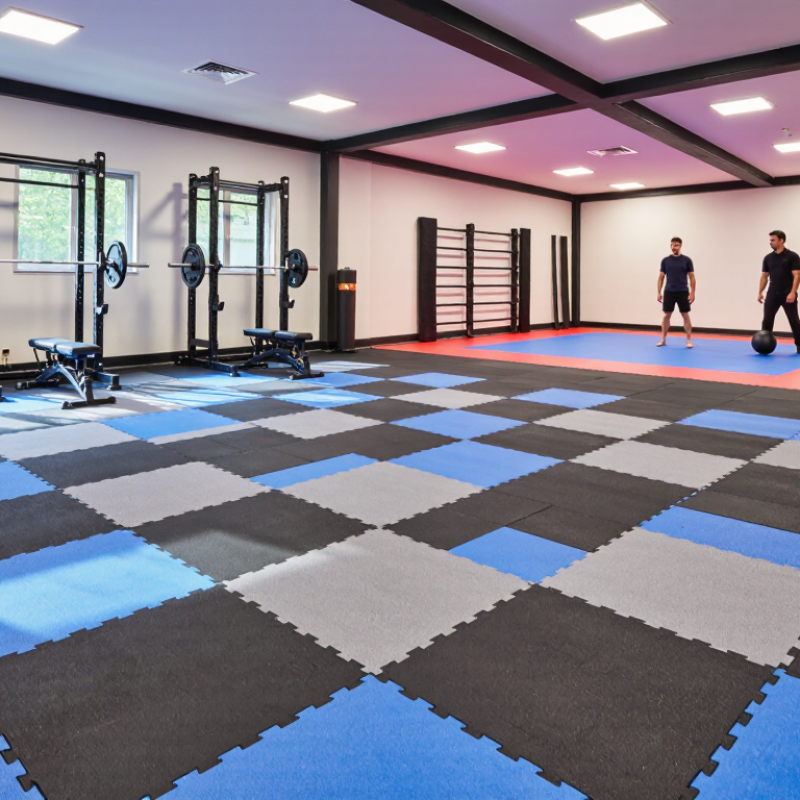
China Top Foam Gym Flooring Manufacturers Suppliers?

Types and Features of Foam Gym Flooring in China

Foam gym flooring in China is available in EVA tiles, roll mats, and interlocking puzzle panels. Each type serves a different training environment. EVA tiles are lightweight and easy to replace, while dense roll mats provide fewer seams under sleds and free weights. Interlocking panels suit home gyms and temporary studios because installation needs no adhesive. Some suppliers combine multiple foam densities, creating a softer surface for stretching and a firmer layer for resistance training.

According to the 2024 IHRSA Global Report, fitness facilities worldwide serve more than 180 million members. This demand encourages Chinese manufacturers to improve shock absorption, surface texture, and dimensional stability. A 2024 Grand View Research analysis also identifies Asia-Pacific as a leading growth region for sports flooring.

Buyers should request density, tensile strength, compression-set, and slip-resistance data, not only attractive samples. EN 14904 and ASTM F1292 can guide impact and safety discussions, although neither replaces application-specific testing.

No foam tile is perfect. Softer foam feels comfortable but may show dents beneath racks. Dark surfaces hide dirt, yet they can reveal chalk marks quickly. A reliable supplier should provide batch samples, test records, edge measurements, and clear replacement terms before shipment.

How to Evaluate Chinese Foam Gym Flooring Manufacturers

How to Evaluate Chinese Foam Gym Flooring Manufacturers

Evaluating Chinese foam gym flooring manufacturers requires more than comparing online prices. Start by checking factory experience, production capacity, and material knowledge. Ask whether the supplier produces foam sheets, finished tiles, or both. This distinction affects consistency and lead times. Request recent test reports for density, compression recovery, slip resistance, and emissions. Reports should match the exact product, not a similar sample.

Order samples from different production batches. Check edge accuracy, surface texture, odor, and color stability under strong indoor light. Press the foam repeatedly with a weighted object, then measure recovery after several minutes. I also inspect packaging, because crushed corners often reveal weak quality control. A reliable manufacturer should explain foam density, thickness tolerance, adhesive compatibility, and expected service conditions clearly. Vague answers deserve caution.

Audit the factory remotely or in person. Review incoming material records, calibration labels, final inspection sheets, and rejection procedures. Ask how they handle uneven flooring, temperature changes, and replacement orders. Communication matters too. Can the technical team provide drawings and packing details without constant correction? I have accepted attractive samples before and regretted ignoring small inconsistencies. Price is only one risk. A useful evaluation may include a pilot order, independent inspection, and written acceptance standards. Leave room for improvement; even a careful process can miss a manufacturing defect.

Leading Manufacturing Regions and Supplier Capabilities

China Top Foam Gym Flooring Manufacturers Suppliers?

Leading Manufacturing Regions and Supplier Capabilities

China’s foam gym flooring supply chain is concentrated in several practical manufacturing regions. Zhejiang and Jiangsu commonly support foam processing, mold production, and export logistics. Guangdong adds strong packaging, tooling, and international shipping resources. These clusters help suppliers source sheets, adhesives, films, and cartons locally. Lead times may still change during peak seasons.

Good suppliers usually offer EVA or PE foam tiles, rolls, and interlocking mats. They can adjust density, thickness, hardness, color, and surface texture. Some factories use compression molding for stable dimensions and cleaner edges. Others rely on lamination or die cutting for faster custom orders. Ask for production samples. Photos are not enough.

Experienced buyers should inspect rebound, compression set, odor, slip resistance, and dimensional tolerance. A reliable factory records batch numbers and checks thickness during production. Independent laboratory testing can verify material safety and performance claims. Export experience also matters, especially for moisture-resistant packaging and container loading. Yet no supplier is perfect. Color variation can appear between batches, and custom molds may need revision. Request a written quality standard, sample approval sheet, and clear replacement policy before placing a large order.

China Top Foam Gym Flooring Manufacturers Suppliers? - Leading Manufacturing Regions and Supplier Capabilities

Regional comparison of common manufacturing strengths and typical foam gym flooring capabilities in China

Manufacturing Region Typical Production Strength Common Foam Flooring Formats Typical Technical Range Customization Capabilities Suitable Buyer Requirements Recommended Verification Points
Jiangsu and Zhejiang Mature polymer-processing and export-oriented manufacturing base with experience in molded and laminated foam products. Interlocking EVA tiles, roll mats, exercise mats, puzzle mats, and multilayer fitness flooring. Common thicknesses of approximately 10–50 mm; density and hardness can be adjusted by formulation and molding process. Custom colors, surface textures, tile dimensions, edge profiles, packing methods, and private-label packaging. Importers, gym-equipment distributors, commercial fitness projects, and retailers needing repeat production. Check compression-set data, dimensional tolerance, color consistency, odor performance, and batch-to-batch stability.
Guangdong Strong supply-chain access to plastics, packaging, tooling, printing, and consumer-product manufacturing services. EVA foam tiles, home-gym mats, children's activity mats, printed mats, and compact retail-pack products. Frequently offered in lightweight EVA constructions with thicknesses commonly around 8–30 mm, depending on use. Detailed surface patterns, embossed or printed graphics, color matching, retail cartons, rolls, and customized die-cut shapes. E-commerce sellers, sporting-goods wholesalers, home-fitness retailers, and buyers requiring presentation-focused packaging. Confirm print durability, color migration, odor limits, packaging drop resistance, and compliance documentation for the destination market.
Fujian Sports-goods and footwear-related manufacturing ecosystem supporting flexible foam processing and sporting-product development. Training mats, yoga and aerobics mats, EVA puzzle tiles, lightweight protective mats, and laminated foam pads. Common product designs prioritize flexibility, cushioning, portability, and easy cleaning; thickness is often about 6–30 mm. Custom textures, folding or rollable structures, handles, carrying bags, color combinations, and user-specific dimensions. Fitness studios, martial-arts facilities, schools, home-fitness channels, and buyers seeking lightweight products. Evaluate tear strength, recovery after repeated folding, slip resistance, sweat-cleaning performance, and edge durability.
Shandong Broad industrial base with access to polymer materials, machinery, packaging, and larger-volume manufacturing operations. Heavy-duty EVA mats, interlocking gym tiles, protective underlayment, fitness flooring rolls, and mixed-material floor systems. More robust constructions may use approximately 15–50 mm thickness, with performance depending on density, structure, and surface finish. Large-size tiles, reinforced layers, anti-slip surfaces, custom hardness, pallet packing, and project-based specifications. Commercial gyms, training centers, schools, sports facilities, and wholesale projects requiring durable flooring. Request load, indentation, compression-recovery, impact, slip-resistance, and dimensional-stability test results.
Hebei and surrounding northern industrial areas Cost-competitive industrial production with access to domestic logistics networks and general polymer-processing resources. Basic EVA puzzle mats, low- to mid-range exercise mats, protective floor pads, and standard-size foam tiles. Standard products are commonly offered in approximately 10–30 mm thicknesses, with limited or moderate design variation. Standard colors and sizes are widely available; customized molds, packaging, and formulations may require higher order volumes. Price-sensitive distributors, institutional buyers, basic home-gym applications, and standard-product wholesalers. Verify raw-material consistency, odor, surface flatness, shrinkage, carton protection, and actual production capacity before ordering.
Cross-regional capability comparison China’s foam gym flooring supply base generally combines EVA formulation, molding, lamination, cutting, printing, packing, and export logistics. Main options include interlocking tiles, roll flooring, foldable mats, laminated pads, and custom die-cut components. Performance varies significantly by foam density, cell structure, thickness, hardness, surface pattern, and backing material. Most established suppliers can discuss OEM colors, dimensions, packaging, texture, hardness, and basic artwork requirements. The best source depends on durability targets, order volume, certification needs, packaging requirements, and destination-market regulations. Obtain pre-production samples, technical data sheets, third-party test reports where required, and a written quality-control specification.

Note: The specifications shown are typical market ranges and capability descriptions rather than guaranteed specifications for every manufacturer. Final performance should be confirmed through samples, technical documentation, and product testing.

Quality Standards, Customization, and Production Processes

Choosing a foam gym flooring manufacturer requires more than comparing prices. Experienced buyers inspect density, thickness, shock absorption, slip resistance, and dimensional stability. They also request current laboratory reports, production samples, and batch records. Details matter. A reliable supplier should explain the testing method, not only provide impressive numbers.

Customization begins with the training environment. Manufacturers may adjust foam hardness, surface texture, tile size, edge design, and color. Heavy lifting areas often need denser foam, while children’s rooms may require softer surfaces and rounded edges. Fit matters. Ask for a physical sample before approving mass production. A sample can reveal odor, uneven color, weak joints, or a surface that feels too smooth. These small issues are easy to miss in photographs.

Production usually includes raw material mixing, foaming, molding, cooling, cutting, and final inspection. Quality teams should check thickness at several points, measure tile dimensions, and test interlocking accuracy. Packaging also deserves attention because compressed foam may deform during shipping. No factory gets every batch perfect. A slight shade variation can still occur, even with controlled formulas. The important question is how the supplier records, investigates, and corrects it. Buyers should review facility experience, worker procedures, inspection frequency, and after-sales communication before placing a large order. One overlooked weakness can become a costly flooring problem.

China Top Foam Gym Flooring Manufacturers Suppliers: Quality, Customization, and Production

Typical foam flooring thickness varies by application. Lightweight exercise and yoga areas commonly use thinner products, while martial arts and high-impact training spaces require thicker shock-absorbing layers. Final specifications should be confirmed through material testing, dimensional inspection, and application-based performance evaluation.

How to Select and Purchase from a Chinese Supplier

Selecting a Chinese foam gym flooring supplier requires more than comparing online prices. Start with the product’s actual specifications: foam density, thickness, hardness, surface texture, edge design, and impact performance. Ask for samples from the same production batch planned for your order. A showroom sample can look excellent, while bulk flooring may differ slightly.

Request test reports for shock absorption, slip resistance, compression recovery, and harmful emissions. Confirm which laboratory issued each report and whether the testing date is recent. You should also check factory capacity, quality-control procedures, production lead time, minimum order quantity, and packaging details. A video call can reveal storage conditions, cutting equipment, and how finished tiles are inspected. It is not a complete audit, but it provides useful evidence.

Tips: Place a small trial order before committing to large volume. Measure tile dimensions, surface smell, color consistency, and edge accuracy after delivery. Discuss payment terms, shipping responsibilities, replacement rules, and inspection rights in writing. Independent pre-shipment inspection is worth considering, especially for large orders. Do not choose the cheapest quotation automatically. I once underestimated packaging space and paid more for freight than expected. That mistake still matters. Keep communication clear, with drawings, photos, tolerance limits, and approved samples attached to the purchase agreement.

1 5