
The best Round Counter Stools in 2026 do more than complete a kitchen island. They need to feel steady on hard flooring, fit beneath the counter, and stay comfortable through breakfast or a long conversation. A stool can look striking in a product photo, then feel cramped when its arms catch the counter edge. Small details matter.
Ergonomics researcher Dr. Alan Hedge’s work offers a useful lens on seating comfort. In paraphrase: a seat should fit the person and the task, not just the room. That is a helpful standard, though it cannot replace trying a stool in your own space. Counter height, seat height, footrest position, and the amount of legroom all affect everyday use. Measure carefully.
This guide compares Round Counter Stools by practical features, including seat shape, swivel action, back support, materials, and stability. It also considers how a rounded seat works in compact kitchens, where sharp corners can interrupt movement. Some shoppers may prefer a cushioned seat; others may value wipe-clean finishes or a smaller footprint. There is no single best choice for everyone.
Expect trade-offs. A broad seat may feel welcoming but occupy more room, while a slim profile can look neat and offer less support. We’ll look at what works, what deserves a second thought, and which details are easy to overlook before buying. A few measurements can prevent a costly mismatch.
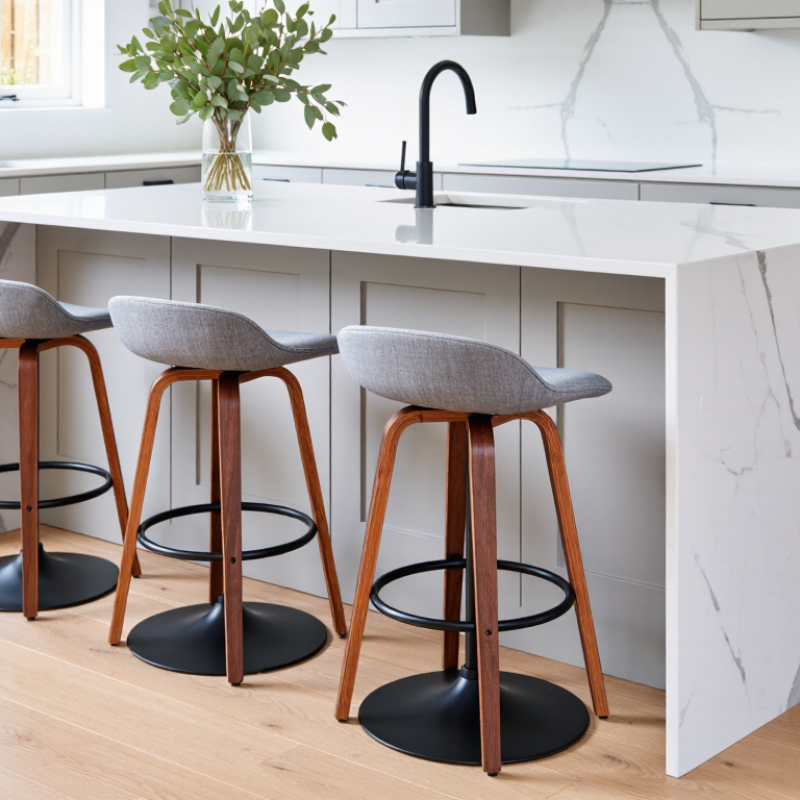
A round counter stool is defined by its circular seat and counter-level proportions, not by one fixed frame style. The seat may rest on four legs, a central pedestal, or a swivel base. What matters is a comfortable fit at the counter.
For a counter about 36 inches high, a seat around 24 to 26 inches high often leaves useful legroom. Measure your own counter, though; overhangs and thick tops can change how a stool feels.
The rounded seat can soften a room’s lines and make it easier to turn toward conversation. Check the edge, too. A gently curved rim feels more comfortable than a sharp one during a long breakfast.
A footrest helps support the legs, while a stable base prevents wobbling on hard floors. Small details count. If the stool swivels, test whether it turns smoothly without striking nearby cabinets.
Materials should suit daily use: sealed wood wipes clean, while textured fabric may hold crumbs. These are useful checks, not guarantees; even a well-built stool can feel wrong if its seat is too narrow or its height mismatched.
The right seat height makes a counter stool feel comfortable rather than awkward. Most kitchen counters stand about 34 to 36 inches high, and seats around 24 to 26 inches usually leave useful legroom. Aim for roughly 9 to 12 inches between the seat and the counter’s underside.
Measure twice. A thick countertop, support rail, or decorative apron can reduce that space, even when the counter looks standard. Measure from the floor to the lowest point your legs may touch, not just to the countertop surface. That detail is easy to miss.
Round seats can be especially practical in tight kitchens because their edges are easier to move around. Still, seat height matters more than appearance. If several people will use the stools, check that everyone can sit with feet supported and shoulders relaxed. A footrest helps, particularly with taller seats. Try a stool at home if possible; showroom floors and real counters can feel different. I would not rely on a listed height alone. Small measuring errors happen, and a few inches can change the whole seating position.
When comparing round counter stools, start with the seat material and how it will handle daily use. Solid wood feels warm and can be refinished, but spills need prompt attention. Metal is durable and easy to wipe clean, though it may feel cold without a padded seat. Upholstered fabric adds comfort, but textured weaves can hold crumbs. Faux leather is simpler to clean, yet quality and wear resistance vary. No material is perfect.
Measure your counter before shopping. A seat height of about 24 to 27 inches often suits a 34- to 36-inch counter, but check the actual clearance. Measure twice. Compare base designs, too: four legs can feel reassuringly stable, while a pedestal base leaves more room for feet. Look for a broad, weighted base, floor-protecting glides, and a footrest that feels comfortable when seated. A swivel seat is handy in tight kitchens, but it should turn smoothly without wobbling. Consider seat diameter, back support, and the stated weight capacity. I’d give stability more weight than extra features; still, it’s easy to underestimate how much a supportive backrest matters during a long meal.
| Stool Type | Seat Material | Base | Typical Seat Height | Comfort and Features | Advantages | Points to Check | Best Suited For |
|---|---|---|---|---|---|---|---|
| Upholstered round stool | Fabric or faux leather over foam padding | Four legs, often wood or metal, with a footrest | About 24–27 in (61–69 cm) | Padded seat; some models add a backrest or swivel | Comfortable for longer meals; many upholstery colors and textures | Check cleaning instructions, foam firmness, seat diameter, and whether the fabric is stain-resistant | Kitchen islands and dining areas used for extended sitting |
| Solid-wood round stool | Solid wood, sometimes with a shaped or contoured seat | Four wooden legs or a wood pedestal | About 24–27 in (61–69 cm) | Usually fixed-height; a footrest may be built into the frame | Durable appearance; can be refinished depending on the finish and construction | Look for stable joinery, a smooth finish, and a footrest that is comfortable for your height | Traditional, rustic, or natural-material interiors |
| Metal-frame round stool | Wood, metal, plastic, or padded seat | Steel or other metal legs, often with a crossbar footrest | About 24–27 in (61–69 cm) | May be stackable; some designs include a backrest or swivel | Often easy to wipe clean; a simple frame can suit compact spaces | Check for floor-protecting feet, corrosion-resistant finish where needed, and a stable frame | Busy kitchens, casual dining, or spaces where easy cleaning matters |
| Pedestal or swivel round stool | Commonly upholstered, wood, or molded plastic | Central pedestal with a weighted or broad base | Fixed counter-height models are commonly about 24–27 in (61–69 cm) | Often swivels; some models have a backrest or adjustable height | Swivel access can make it easier to sit down and turn toward the counter | Confirm the height range, base footprint, swivel action, and whether the base can be secured or adjusted as intended | Islands where easy entry and turning are priorities |
| Molded-plastic round stool | Molded plastic, sometimes with a padded seat insert | Metal legs or a molded pedestal | About 24–27 in (61–69 cm) | Usually lightweight; backrests and footrests vary by design | Simple to wipe clean; useful where spills are common | Check seat shape, surface texture, stability, and the manufacturer’s stated weight capacity | Family kitchens and low-maintenance spaces |
| Backless round stool | Wood, metal, plastic, or upholstered seat | Four legs or a compact pedestal | About 24–27 in (61–69 cm) | Compact design; a footrest is especially useful for seated comfort | Can tuck under a counter and take up less visual space | Consider how long people will sit and whether the seat has enough padding or contouring | Small kitchens and counters where stools need to be tucked away |
Comparison note: A counter-height seat is commonly around 24–27 in (61–69 cm), but dimensions vary by model. Measure from the floor to the underside of the counter and leave room for comfortable leg movement. Weight limits, seat dimensions, materials, and features are product-specific; check each stool’s published specifications before buying.
Top round counter stools differ most in comfort, footprint, and how easily they move around a busy island. Houzz’s 2025 U.S. Kitchen Trends Study reports that 77% of renovating homeowners changed their kitchen island; 35% added one, while 42% upgraded an existing island. That makes stool fit more than a styling choice. A compact pedestal base leaves more floor visible, while four legs can feel steadier but occupy more space. Swivel seats help when people turn between the counter and nearby seating. Not always. In a narrow kitchen, swiveling can cause bumps.
Seat height is a practical dividing line: most counter-height stools suit counters around 34 to 36 inches, with roughly 9 to 12 inches between seat and counter underside. Check the actual counter, not just the listing label. Round seats soften a hard-edged island, but a small seat may feel cramped during a long meal. Upholstery adds comfort and warmth; wipeable wood or metal is often easier around spills. A backrest supports lingering, though it can prevent stools from tucking fully beneath the counter. Measure the overhang and allow about 24 inches of counter width per person, a common kitchen-planning guideline. That number is useful, not magic; elbows and bulky bases still need room.
How the right seat height differs by counter height
A comfortable stool typically leaves about 10–12 inches between the seat and the underside of the counter. For standard 34–36-inch kitchen counters, that generally means a 24–26-inch seat; for 40–42-inch bar-height surfaces, a 28–30-inch seat is a common fit. Check your counter’s actual height before choosing a stool.
A round counter stool can soften a kitchen’s hard edges, but its footprint still matters. Measure the counter height and the space beneath it before shopping.
For a standard 36-inch counter, a seat around 24 to 26 inches high often leaves comfortable legroom. Aim for roughly 10 to 12 inches between the seat and counter underside, then check the stool’s full width.
Three seats may fit on paper and still feel crowded when people pull them out.
Measure twice.
Match the shape to how the room works.
A backless stool tucks neatly under a narrow overhang, while a low back can feel steadier during longer meals. If children or older adults will use it, prioritize a stable base, a useful footrest, and a seat that is easy to climb onto. A swivel can help in a tight layout, though it may bump nearby cabinets.
Small details matter.
Set a budget that includes upkeep, not just the purchase price.
Metal and sealed finishes are usually simple to wipe clean; textured upholstery may need more attention after spills. Compare the frame, joints, weight limit, and return terms rather than choosing by appearance alone.
I still find finishes hard to judge from a screen. If possible, sit on a similar stool before deciding.
